
COMMUNITY MANAGED DISASTER RISK REDUCTION
People of eleven drought prone and four flood prone communities are resilient
to drought and flood in Tirunelveli District, Tamil Nadu
Project Overview
Area of Operation: Eleven drought prone communities (Eraippuvari, Elangal, Arumaneri, Silayam, Eduppur, Chinthamani, Lethikulam, Kallathi, Padapparkulam, Koonthakulam, Seelathikulam) and four flood prone communities (Melapathai, Moongiladi, Pachandiram, Pallikondankudiruppu) in Tirunelveli District.
Project Period: 01.03.2008 to 31.12.2011
Target Population
| People at risk to the hazard | Men | Women | Children | Disabled | Old aged | Total |
|---|---|---|---|---|---|---|
| Drought | 1767 | 2173 | 702 | 31 | 201 | 4774 |
| Floods | 1180 | 1359 | 170 | 17 | 85 | 2711 |
The identification of drought risk factors by the community:
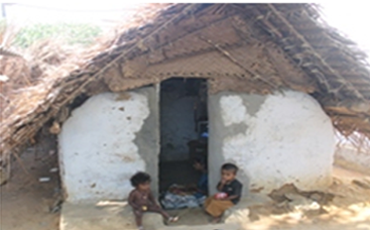
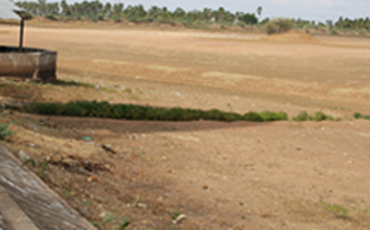
- Shortfall of average rain falls - 600 mm per year.
- Existing irrigation tanks are covered with silt, Julie flora; bunds damaged.
- Lack of feeder canals or damaged feeder canals to the existing ponds.
- Lack of percolation tanks for collecting runoff rain waters.
- No linkage with Tamirabarani Comprehensive Drinking Water distribution system.
- Lack of adequate overhead drinking water tanks and delivery systems.
- Lack of knowledge on drought-resistant crops & utilization of minimum water resources.
- Non-compliance of minimum wages under NREGS.
- Lack of employment beyond 100 days under NREGS.
- Non-availability of subsidy schemes for cattle rearing.
- Lack of savings habit in community.
- Lack of access to government welfare schemes (BPL rice, scholarships, pensions, etc.).
- Lack of food grain storage facilities.
- No Village Information Centre for early warning on disasters.
- Lack of District Disaster Management Authority, DRR plan, and mitigation fund.
- Lack of knowledge on insurance & crop insurance.
- Lack of EDP for youth, PWD, and women.
- Lack of basic knowledge on disaster risk analysis and management.
The identification of flood risk factors by the community:
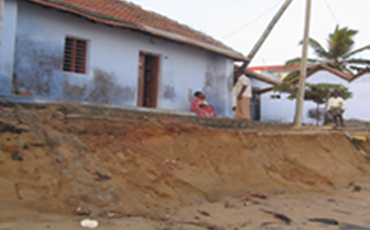
- Poorly engineered houses located in vulnerable areas.
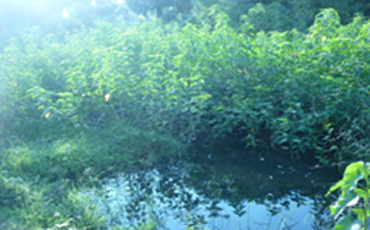
- Channels silted with mud and bushes, blocking free water flow.
- Both sides of canal bunds are weakened.
- Lack of house site title deeds along canal banks.
- Lack of knowledge on flood-resistant cropping systems.
- Lack of protected drinking water.
- Lack of toilet facilities.
- Lack of crop insurance schemes.
- Lack of protection for crops from wild animals.
- Lack of rescue centres during disasters.
- Lack of savings habit in community.
- Lack of access to government welfare schemes.
- Lack of alternative employment opportunities.
- No Village Information Centre for early warning.
- Lack of District Disaster Management Authority, DRR plan, mitigation fund.
- Lack of knowledge on insurance & crop insurance.
- Lack of EDP for youth, PWD, and women.
- Lack of basic knowledge on disaster risk analysis and management.
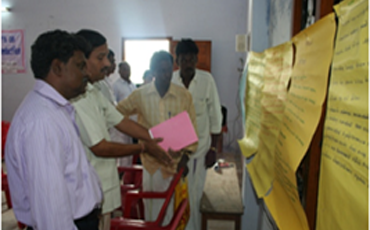
RUC facilitated the community and the "Task force" to plan disaster risk reduction activities. The community and the task force evolved the following plan:

- Deepen ten major ponds and a supply canal by removing silt and Julie flora. Strengthen bunds around tanks.
- Advocacy and lobbying with government for:
- Construct percolation tanks and separate link canals from major reservoir to irrigation tanks.
- Maintenance of sluices in tanks for irrigation water supply.
- Link villages with Tamirabarani comprehensive drinking water supply scheme.
- Provide additional drinking water facilities.
- Enhance NREGS working days from 100 to 200 and increase daily wages.
- Constitute District Disaster Management Authority, prepare DRR plan, allocate mitigation fund.
- Avail government welfare schemes (BPL rice, scholarships, pensions, patta land, permanent houses, etc.).
- Allot land for Disaster Management Information Centre and food grain storage.
- Identify drought-resistant crops and capacitate farmers.
- Capacity building on animal husbandry and subsidies for landless cattle owners.
- Assistance to Persons with Disability for Income Generation Programme.
- Introduce small savings & microcredit facilities.
- Construct village Disaster Management Information Centres and food grain storage facilities.
- Facilitate enrollment in insurance and crop insurance schemes, request government to pay premium.
- Entrepreneurship Development Programme for youth, PWD, and women.
- Conduct public meetings, training, mock drills, leadership orientation, social forestry, mobilize community fund, orientation on government welfare measures.
- Conduct DRR orientation for children and community for various hazards.
- Contingency plan for ensuring drinking water facilities.
- Maintenance or rebuilding of 144 houses in four villages.
- Maintenance work and construction of retention walls in Patchandrum and Moongilady.
- Government to undertake maintenance work in Nangunerian canal.
- Link villages with Tamirabarani drinking water supply scheme and provide additional facilities.
- Avail government welfare schemes (BPL rice, scholarships, pensions, patta land, permanent houses, etc.).
- Allot land for Disaster Management Information Centre and rescue centres.
- Constitute District Disaster Management Authority, prepare DRR plan, allocate mitigation fund.
- Identify flood-resistant crops and capacitate farmers.
- Facilitate enrollment in insurance and crop insurance schemes, request government to pay premium.
- Provide microcredit assistance to farmers.
- Entrepreneurship Development Programme for youth, PWD, and women.
- Establish rescue centres and Disaster Management Information Centres in four villages.
- Conduct public meetings, mock drills, orientation on social forestry, government welfare measures, mobilize community fund, leadership trainings.
- Conduct DRR orientation for children and community for various hazards.


- The disaster risk reduction task force committee with the support of RUC conducted various capacity building programmes to facilitate the community with the CMDRR process/risk reduction monitoring.
- Five days capacity building training on risk analysis.
- Two days motivation and leadership training.
- Six days public meetings and half-yearly meetings on community-managed disaster risk reduction.
- One public meeting in each of the 11 villages on the importance of life insurance.
- Two days orientation programme on welfare measures for livelihood.
- One day mobilization of community fund.
- One day orientation programme on social forestry for livelihood.
- Two days intensive training for CMDRR task force leaders.
- Awareness campaigns to task force leaders and youth on life insurance with support of insurance companies.
- One-day capacity building on EDP and two days on income generation & management workshop for 31 physically challenged people with Rs.5000/- subsidy each.
- Thirteen volunteers oriented on DRR syllabus preparation; 80 classes conducted for 917 school students.
- 307 youth from 11 villages facilitated for continuation of technical education.
- Expert study on flood and drought resistant cropping patterns; 18 days orientation on organic farming including 2 days exposure for 117 farmers.
- 602 landless poor beneficiaries trained in animal husbandry and provided Rs.4000/- subsidy each for cattle purchase; insurance coverage arranged.
- DRR Task force identified land and supervised construction of Disaster Risk Reduction Information Centre cum food grain storage with community participation.
- Disaster Management Information Centre established with internet facility; volunteers trained on internet operations; displayed contact details of all relevant authorities and stakeholders.
- IEC materials prepared and distributed on life insurance, disaster awareness, CMDRR syllabus, organic farming, NREGS, government welfare schemes, risk reduction measures.
- IEC materials prepared in Tamil and distributed to the 11 villages.
- Memorandums prepared for Disaster Risk Reduction & development action programmes submitted to Panchayats, Tamil Nadu Water and Drainage Board, MLA, District Collector, Chief Minister, Tahsildars etc.
- Facilitated the community to avail drought mitigation measures from the Government.
- Capacity building training for Government officials and task force members in Kanyakumari District, fire service & rescue team, and ICD workers cum Disaster Management Educators.
- Policy advocacy conducted with State Executives, Legislatures, Deputy Chief Minister, and Chief Minister to constitute State Disaster Management Authority.
- Workshops conducted for NGOs and People's Movement leaders on Climate Justice, including state-level workshops with Tamil Nadu Coordination Committee on Campaign against Global Warming.
- Students and parents sensitized to demand climate justice; 500 children and community leaders campaigned at Kanyakumari for global climate justice fund and technology transfer.
- Coordination meetings held with Panchayat President and members; consortium of PRI members formed for better drought mitigation implementation.
- 975 families able to cultivate paddy; ten water bodies and one supply channel deepened and strengthened.
- Organic farming training enabled 439 farmers to cultivate drought-resistant crops.
- 602 landless poor rearing milch animals earn additional monthly income of Rs.500–1000/-.
- 31 physically challenged people engaged in income generation activities earn Rs.800–1500/- per month.
- 307 youth trained in skills earn Rs.4500/- monthly.
- 4180 persons aware of Government welfare measures; 698 persons saved for drought preparedness.
- 263 people availed credit facilities to start income-generating activities, earning Rs.1500/- monthly.
- 1065 persons made aware of insurance; 2738 joined life insurance schemes.
- 917 children are aware of disaster risks and climate change impacts.
- Drinking water scarcity reduced in seven villages due to RUC-installed water systems.
- Food grain stores ensure food security in drought across 11 villages.
- Mock drills and first aid training enabled task force to respond effectively.
- Information Centre enabled hazard information exchange and early warnings.
- DRR Task force, six sub-committees, and Panchayats functioning with defined roles and contingency plans.
- Majority of people in 11 communities resilient to drought risk.
- 144 families reconstructed their houses and are relieved from the risk of flood.
- Four rescue centers constructed; ensured refuge for affected families.
- Drinking water availability ensured in four villages, benefitting 671 families.
- Communities flood risk free due to silt removal and construction of retention walls.
- 17 physically challenged people engaged in income generation earn Rs.800–1500/- per month.
- 1600 families from 18 villages restored normal life.
- Awareness campaigns on Life Insurance led 2825 families to join schemes.
- 713 families made savings and prepared for flood season.
- 134 children taught DRR knowledge and climate change impacts.
- 321 people used credit facilities to start income-generating activities earning Rs.1500/- monthly.
- 32 farmers cultivated paddy and plantains during December Rabi Season due to organic farming training.
- Mock drills and first aid trainings improved emergency response.
- DRR Task Force, sub-committees, and Panchayats function effectively with contingency plans.
- Majority of people in four communities resilient to drought risk.
- Government of Tamil Nadu constituted State Disaster Management Authority and issued notification.
- Tirunelveli district declared drought prone; disaster risk reduction activities implemented, tanks deepened/strengthened under NREGA.
- 28 percolation tanks constructed to collect rainwater, improving irrigation and groundwater levels.
- Maintenance of sluices in all village water bodies to regularize water supply.
- Additional drinking water facilities linked with Tamirabarani supply system benefitting 7253 persons.
- District Collector approved food grain storage buildings and Disaster Management Information Centres; Panchayats assigned management responsibility.
- Land tax withdrawn for two years in the drought-prone district.
- 5.5 lakh Beedi workers received wage increment of Rs.12.35/- per 1000 beedies through tri-party agreement.
- NGOs sensitized on CMDRR strategy and policy advocacy to enhance community resilience.
The community along with the Drought Risk Reduction Task Force conducted monitoring in February 2011. Most drought risk factors were eliminated or reduced. A revised risk reduction map was prepared marking unresolved risk in red, moderate in blue, and fully reduced in green. The contingency plan was also updated.
The risk reduction monitoring exercise helped the community and DRR Task Force prepare an action plan for responding to severe drought and flood in the future.
- Judicious utilization of drinking water.
- Creating Community fund for disaster response.
- Saving & storage of maximum possible food grains for the community and cattle.
- Conducting mock drills periodically.
- Maintaining existing water sources.
- Planting more trees in and around villages.
- Popularizing organic farming.
- Engaging local Panchayat and Government to undertake climate change adaptation measures.